By: Troy Johnson | Published on: Sept 30, 2026
The Turkish crop story continues to evolve, and it's worth a fresh update so you have the best information available to make good buying decisions.

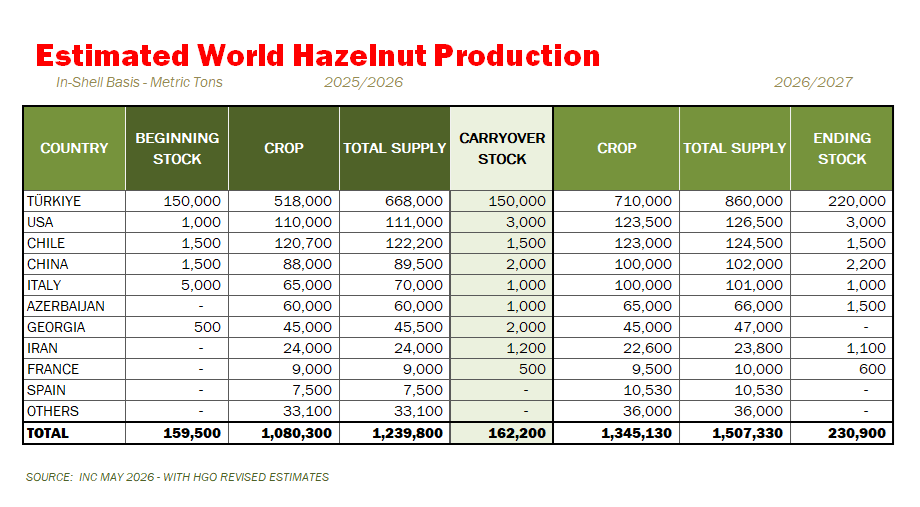
Just a few weeks ago, some estimates out of Turkey were as high as 900,000 metric tons. That number has not held up. A growing number of contacts on the ground are now pointing to something closer to 700,000 metric tons as a realistic expectation for this crop, driven by poorer than expected quality and a high incidence of blank nuts in multiple growing regions.
Weather has been part of the problem. Continued rainfall in the Eastern Black Sea and Akçakoca regions has delayed the new crop and raised real concerns about the sorting costs processors will face to get material to merchantable quality. TMO is responding by holding a hard line on quality — it is reportedly refusing batches mixed with old-crop material and banning growers who bring in such batches for two years, a sign that authorities are just as concerned about crop-year integrity as buyers should be.
That concern is well founded. Export data shows a meaningful share of what is being declared and shipped as “new crop” may not be. Some of our contacts estimate that as much as 80% of recently reported new-crop shipments could actually be old crop moving under the new-crop declaration. Whether that number proves precisely accurate or not, the pattern is consistent enough that buyers should take it seriously.

Italy
Italy's crop is also coming in lighter than expected. Early-summer estimates put the Italian crop near 150,000 MT; the more likely outcome now looks closer to 100,000 MT.
USA
Here in Oregon, the crop is looking exceptional. Growing conditions have remained ideal all year, and quality indicators are strong. Harvest of early varieties has begun, and we expect a steady stream of grower deliveries over the next 4 to 8 weeks. At a time when several other origins are fighting weather and quality problems, Oregon's crop stands out as a bright spot in the global picture.
Chile
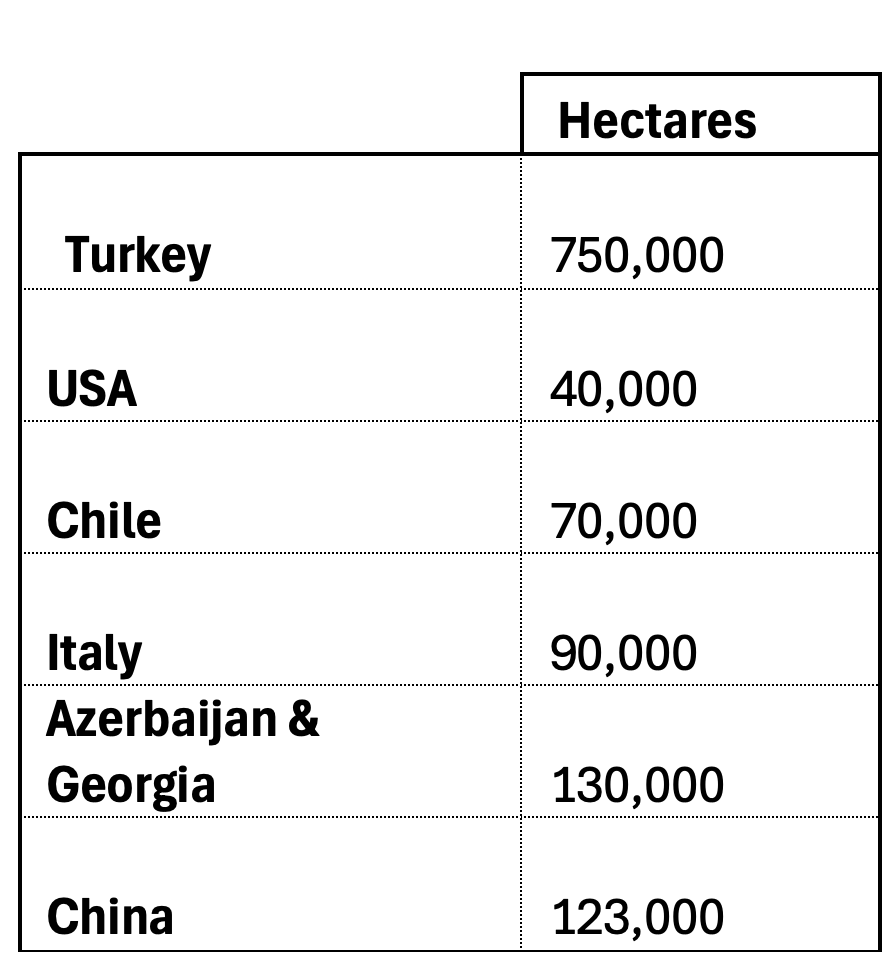
For all intents and purposes, Chile will likely produce another record crop next March, driven by the large number of hectares planted that will come into production or maturity. However, there are reports that pollination throughout parts of the growing region may have been hampered by excessive rains and poor conditions. This will be something to monitor more closely in several months.
Other Origins
Georgia and Azerbaijan are both dealing with quality issues tied to unsettled weather since harvest began, though conditions in Azerbaijan have improved recently and offers from that origin are expected within the next couple of weeks.
The Supply Picture: Abundant, Not Oversupplied
Put it all together — a smaller than expected but still adequate Turkish crop, a lighter Italian crop, weather-challenged Georgian and Azerbaijani crops, and strong crops from the USA and Chile — and the global supply picture looks abundant but not oversupplied. There should be enough hazelnuts in the world this year for buyers to secure reasonably priced hazelnuts, provided they're working with the right partners and paying attention to quality and crop-year integrity. Without a doubt, there is a growing supply of lower, or substandard, quality that is best suited for oil or poorer quality paste stock. Unfortunately, there is no accounting for the levels of quality among the origins and therefore the total supply lumps the bad in with the good. It is for this reason that we feel the supply level isn’t in fact a bumper supply, and instead we only have an adequate level of fine quality product to service the market. Processors do need to find alternative avenues to push the lower quality into, instead of watering down good quality by mixing in poorer quality.
The Opportunity: Grow the Pie
This is also a moment of real opportunity for the industry. Pistachios are facing a tremendously low crop relative to demand, and almonds are seeing their first decline in acreage in 30 years. Both of those commodities have made significant inroads into the ingredient market over the past several years — segments that hazelnuts can and should be focusing on.
With adequate, reasonably priced supply available, hazelnut marketers and processors have an opening to bring new customers and new applications into the category rather than simply competing for existing demand. Hazelnuts deserve to be positioned not as a substitute when other nuts are tight, but as a first-choice ingredient for new product development — a versatile, flavorful, and increasingly available option for R&D teams looking for their next win.
The industry's job right now isn't just to divide up the existing pie — it's to make the pie bigger. That means continued investment in promotion, education, and demand generation so that hazelnuts capture the kind of ingredient-market growth that almonds and pistachios have enjoyed. The Mintel Group is forecasting that hazelnuts will be the fastest growing within the nut sector over the next 3 – 5 years.
The supply of good quality hazelnuts is here to promote new product development and growth.
Most recent news from Turkey (received today): "It is the consensus across all markets that the price of in-shell hazelnuts, currently in the range of 180-190TL/kg, will increase by 30% in one month...Currently, there is a 30% price difference between the TMO's shelled hazelnut purchase price and the free market price."
My opinion on this take, is that is a very bold statement and if that is the case then the amount of good quality hazelnuts is less than expected. We are not prescribing to this thought but will be following the situation in Turkey closely.